0%

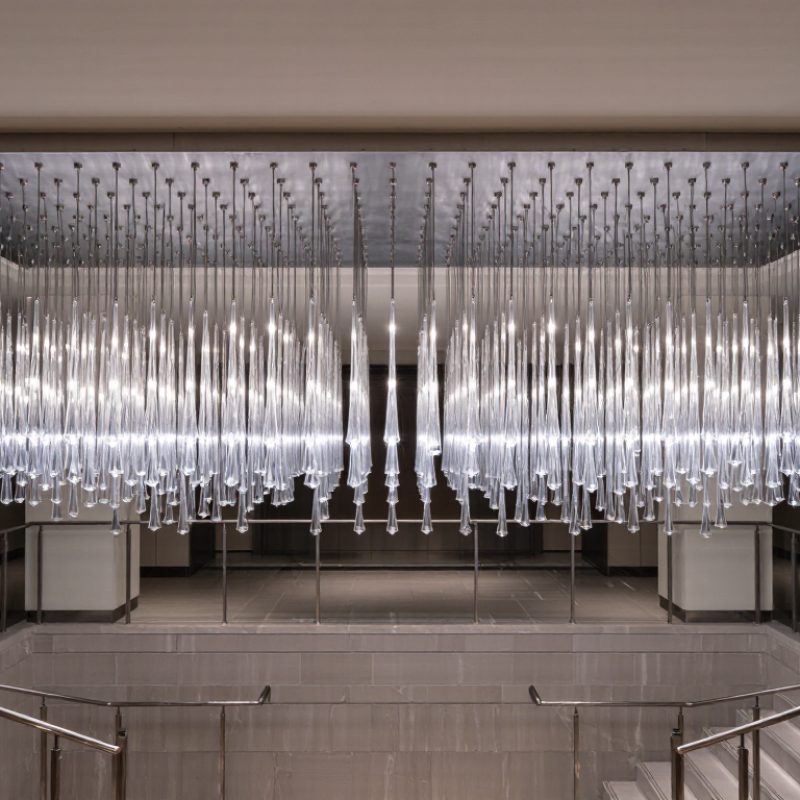
Custom Crystal Canopy Lighting combines architectural illumination with a decorative crystal structure suspended from a ceiling. It usually includes a metal canopy, crystal prisms, LED modules, drivers, and concealed wiring. Unlike a standard chandelier, its dimensions, crystal pattern, finish, brightness, and suspension length are made for a specific interior. The result may resemble a glowing ceiling sculpture above a hotel lobby, staircase, dining table, or luxury retail entrance.

Market evidence supports this design direction. Grand View Research reports that the global LED lighting market was valued at approximately USD 78 billion in 2023, with continued growth expected through 2030. The U.S. Department of Energy also reports that LED products can use at least 75% less energy than incandescent lighting. These figures do not measure crystal fixtures directly. However, they explain why designers increasingly combine expressive forms with efficient LED technology. The Illuminating Engineering Society recommends evaluating visual comfort, color quality, controls, and maintainability, not appearance alone.

A well-planned Custom Crystal Canopy Lighting system should specify color temperature, color rendering, dimming compatibility, ceiling load, access for cleaning, and driver replacement. Crystal clarity matters. So does the spacing between each drop, because uneven spacing can create distracting glare or dark patches. A poorly coordinated canopy may look impressive in a drawing but feel harsh at eye level. That is an important limitation. Custom work is not automatically better; it requires accurate site measurements, professional electrical review, and careful mock-up testing. In the following discussion, the focus is practical: what this lighting type includes, how it is designed, and where its visual value justifies its added complexity.
What Is Custom Crystal Canopy Lighting?

Definition and Core Features of Custom Crystal Canopy Lighting

Custom crystal canopy lighting is a ceiling-mounted lighting system designed around a specific space, ceiling height, and visual concept. Its canopy supports multiple crystal pendants, rods, or hand-formed elements. Unlike standard fixtures, its dimensions, drop lengths, crystal layout, light output, and finish can be adjusted before fabrication.

Core features include modular wiring, concealed mounting plates, dimmable LED sources, and carefully controlled beam angles. Crystal does not create brightness by itself. It refracts and scatters light, producing highlights across walls, tables, and polished surfaces. The U.S. Department of Energy reports that LED lighting uses at least 75% less energy than incandescent lighting and can last up to 25 times longer. The International Energy Agency also estimates that lighting represents about 15% of global electricity consumption. These figures support efficient light sources, but efficiency should not replace visual testing. A fixture may look elegant in a showroom and feel harsh in a dining room. That trade-off is easy to underestimate.

Tips: Confirm ceiling load capacity before design approval. Measure the finished floor height, not only the structural slab. Select a color temperature between 2700K and 3000K for warmer hospitality spaces. Keep driver access visible. Consider dust on crystal surfaces, ladder access, and future replacement costs. In practice, the first layout is rarely perfect. A small mock-up can reveal glare, uneven spacing, or an awkward hanging rhythm before installation.

What Is Custom Crystal Canopy Lighting?

Custom crystal canopy lighting is a decorative ceiling-mounted lighting system designed around a specific canopy size, crystal arrangement, light color, and installation space. The chart below summarizes common design benchmarks used for high-quality custom fixtures.

Typical specifications include warm white color temperatures, high color rendering, long LED service life, and adjustable crystal drops. Exact values vary according to the room size, ceiling height, and desired visual effect.

How Custom Crystal Canopy Lighting Is Designed and Engineered

What Is Custom Crystal Canopy Lighting?

Custom crystal canopy lighting is a suspended architectural fixture built around a specific ceiling, room, and visual concept. Its design begins with measured drawings, reflected ceiling plans, and a detailed weight schedule. Engineers then coordinate the canopy frame, suspension points, wiring routes, drivers, and heat management. Crystal size matters. Larger pieces increase visual impact, but they also add load and installation risk.

Professional lighting practice treats illumination as both a technical and human factor. The U.S. Department of Energy reports that LED products use at least 75% less energy and last up to 25 times longer than incandescent lighting. Designers can apply this efficiency to layered illumination, using dimmable LED sources behind or above crystal elements. However, glare control remains essential. A bright canopy may photograph beautifully, yet feel uncomfortable below. Structural calculations should also consider dead loads, access requirements, and local building standards. ASCE 7 provides widely used guidance for evaluating building loads and attachment conditions. Still, a perfect drawing is not always a perfect installation.

Tips: Request a full-scale sample before fabrication. Check crystal sparkle, shadow patterns, color temperature, and ceiling reflections. Confirm every suspension point with the project engineer. Leave service access for drivers and connections. Small oversights become expensive overhead problems.

The design may look simple. It rarely is.

Key Materials, Crystal Types, and Lighting Components

What Is Custom Crystal Canopy Lighting?

Key Materials, Crystal Types, and Lighting Components

Custom crystal canopy lighting is a suspended ceiling fixture built around a decorative canopy. The canopy hides wiring, drivers, and mounting hardware above the visible crystals. In practice, its material affects both appearance and durability. Brushed metal provides structure, while polished stainless steel creates sharper reflections. Aluminum reduces weight, which helps with larger installations. The frame must still support the fixture safely.

Crystal types create different visual effects. Optical crystal offers strong clarity and precise light transmission. Lead-free crystal can provide brightness without relying on added lead content. Hand-cut crystal produces varied facets, while molded crystal gives a more consistent pattern. Clear pieces create clean sparkle. Frosted or tinted pieces soften the light and reduce glare. Crystal is not always perfectly uniform, and that can be part of its character.

Lighting components deserve equal attention. LED modules or replaceable lamps control color temperature, brightness, and energy use. Dimmers allow the fixture to shift from a bright lobby atmosphere to a calmer dining setting. Drivers must match the electrical system and fixture load. Suspension cables need accurate adjustment, especially when crystals hang at different heights. I have found that overly bright LEDs can weaken the crystal effect. A slightly imperfect layout may look more natural, but every connection should be checked by a qualified professional.

What Is Custom Crystal Canopy Lighting? - Key Materials, Crystal Types, and Lighting Components

Category Item Typical Specification or Composition Key Performance Characteristics Common Use in a Custom Canopy
Structural Materials Stainless Steel Corrosion-resistant steel, commonly selected in polished, brushed, or plated finishes Strong, durable, and suitable for detailed frames and suspension hardware Primary frame, canopy plate, crystal support rods, and mounting fittings
Aluminum Lightweight metal used for structural profiles, housings, or secondary frames Low weight and naturally corrosion resistant; easier to handle in large installations Large canopy frames, LED housings, and concealed support sections
Brass Copper-zinc alloy with polished, brushed, antiqued, or plated surfaces Good machinability and a warm decorative appearance; heavier than aluminum Decorative trims, sockets, collars, connectors, and visible canopy details
Glass or Acrylic Diffuser Clear, frosted, opal, or patterned transparent material Softens glare and distributes light; glass offers better heat and scratch resistance Light shields, LED covers, decorative panels, and concealed light sources
Crystal Types Lead-Free Optical Crystal Precision-cut glass formulated without intentionally added lead High clarity, consistent refraction, and a lower-weight alternative to leaded crystal General-purpose prisms, pendants, drops, and geometric accents
Lead Crystal Glass containing lead oxide; composition varies by product and regulation High refractive index and strong light dispersion, with increased weight High-impact decorative drops and statement elements where weight is supported
Pressed Crystal Glass Molten glass formed in a mold, often with repeated decorative geometry Consistent shape, scalable production, and generally lower cost than hand-cut pieces Repeated modules, beads, faceted chains, and patterned canopy sections
Hand-Cut or Machine-Cut Crystal Glass shaped and faceted through cutting, polishing, or precision machining Defined facets and bright reflections; quality depends on cut accuracy and polishing Custom motifs, prismatic panels, signature drops, and focal clusters
Lighting Components LED Light Source Integrated LED modules or replaceable LED lamps, commonly available in warm to neutral white Energy efficient, low heat compared with incandescent lamps, and available in dimmable formats Direct illumination, concealed edge lighting, and crystal sparkle enhancement
Lamp Holders and Sockets Heat-resistant electrical fittings matched to the selected lamp base or LED assembly Provide mechanical support and electrical connection; must match voltage and temperature ratings Visible bulb positions, candle-style arms, and replaceable lamp assemblies
LED Driver Constant-current or constant-voltage power supply selected for the LED load Regulates power, supports stable output, and may enable dimming or control integration Remote or concealed power compartment for integrated LED systems
Wiring and Connectors Insulated conductors, terminals, connectors, and strain-relief components rated for the installation Transfers power safely and organizes multiple lighting zones or suspended elements Internal routing, modular crystal strands, and multi-level canopy connections
Dimming and Control System Compatible wall dimmer, digital controller, or building-control interface Adjusts brightness and can separate the canopy into independently controlled zones Hospitality, residential, retail, and architectural installations requiring scene control
Design and Installation Factors Suspension System Aircraft cable, threaded rod, chains, rigid stems, or custom support brackets Determines load capacity, height adjustment, stability, and visual alignment Multi-tier canopies, clustered pendants, and ceiling-mounted crystal arrangements
Canopy Geometry Round, rectangular, linear, sculptural, or custom-profile ceiling structure Controls visual scale, crystal distribution, light coverage, and coordination with the space Feature ceilings, stairwells, reception areas, dining spaces, and double-height interiors
Safety and Maintenance Access Proper anchoring, electrical protection, accessible drivers, replaceable lamps, and cleanable surfaces Supports safe installation, servicing, cleaning, and long-term visual performance All custom canopy projects, especially large or high-ceiling installations

Note: Final material selection, electrical ratings, suspension capacity, and installation methods should be verified against local electrical and building requirements.

Installation Methods and Interior Applications

Custom crystal canopy lighting combines a decorative crystal array with a concealed or visible ceiling canopy. Its installation method shapes the entire interior experience. For heavy fixtures, installers should verify ceiling capacity, junction-box strength, and suspension points before delivery. A reinforced mounting plate suits solid concrete ceilings. Adjustable aircraft cables work well for high lobbies and stairwells. Recessed canopies create a cleaner appearance in dining rooms, bedrooms, and private lounges. Sloped ceilings may require angled adapters or independently adjustable suspension rods.

Electrical planning also matters. The U.S. Department of Energy reports that LED lighting uses at least 75% less energy and lasts up to 25 times longer than incandescent lighting. A custom canopy should therefore use compatible LED modules, dimmers, and accessible drivers. Warm color temperatures can soften crystal reflections in restaurants and hotels. Cooler light may improve visual clarity in retail entrances or reception areas. According to IES lighting practice, glare control and visual comfort remain essential, yet a first mock-up may still look too bright. That is useful feedback, not failure.

Tips: Test one full-size section before final fabrication. Measure the reflected sparkle from eye level. Leave service access above the canopy. Keep crystal components removable for cleaning. Check shadows on tables, floors, and nearby artwork. Do not assume a symmetrical layout will suit every room; slight spacing changes can improve balance. Pair the fixture with quiet ceiling finishes, because glossy surfaces may create distracting reflections.

Maintenance, Safety Standards, and Selection Considerations

Custom crystal canopy lighting combines a suspended structural frame, crystal elements, and integrated light sources.

It is often designed for hotels, galleries, restaurants, and residential foyers. The crystals shape reflections, while the canopy controls glare and visual scale.

Maintenance starts before installation. Inspect cables, anchors, connectors, and crystal fittings during commissioning.

Dust can soften sparkle and increase heat around enclosed LEDs. A practical schedule includes monthly visual checks and professional electrical inspections at least annually.

Wipe crystals with a soft, lint-free cloth; avoid abrasive chemicals.

Do not ignore small rattles. They may indicate a loose fastener or stressed support.

Safety depends on engineering, not appearance.

The supporting ceiling must carry the complete dead load, including moisture and cleaning equipment. Electrical work should follow the locally adopted code, with NFPA 70 and UL 1598 commonly used as reference points for wiring and luminaires.

Emergency access matters. So does fall protection during cleaning.

The International Energy Agency reports that lighting uses about 15% of global electricity, making efficient LEDs and compatible dimming controls sensible selection factors.

Choose a suitable color temperature, high color rendering, and an appropriate IP rating for humid spaces.

Confirm thermal clearance, driver access, and replacement-part availability before approval.

A beautiful canopy that cannot be serviced is a costly design mistake. I have seen this overlooked.

FAQS

What is custom crystal canopy lighting?

It is a suspended ceiling fixture made for a specific room. Crystal elements shape reflections and shadows. The canopy manages structure, wiring, glare, and visual scale. It looks simple. It rarely is.

How is a crystal canopy designed?

Designers begin with measured drawings and ceiling plans. Engineers review weight, suspension points, wiring routes, and heat clearance. Crystal size affects both appearance and structural load. A perfect drawing can still mislead during installation.

How can a heavy canopy be installed safely?

Confirm ceiling capacity before delivery. Check anchors, junction boxes, mounting plates, and suspension points. Solid concrete may need a reinforced mounting plate. High spaces may use adjustable suspension cables. Never guess the support strength.

Can the fixture work on a sloped ceiling?

Yes, but standard suspension may not align correctly. Angled adapters or independently adjustable rods can help. Installers should check the final height from several viewing positions. Small errors become obvious over a dining table.

What lighting color works well with crystal elements?

Warm light can create softer reflections in dining areas and lounges. Cooler light may improve clarity in entrances and reception spaces. Use dimming to reduce glare during different activities. The brightest setting is not always the best setting.

Why is a full-scale sample important?

A sample reveals sparkle, shadows, glare, and ceiling reflections. View it from eye level, not only from below. Test it near tables, floors, and artwork. One sample may expose an expensive design mistake.

How should crystal canopy lighting be maintained?

Inspect cables, anchors, connectors, and fittings during commissioning. Perform monthly visual checks and regular professional electrical inspections. Wipe crystals with a soft, lint-free cloth. Avoid abrasive chemicals. Small rattles need attention.

What should be checked before final approval?

Confirm driver access, thermal clearance, replacement parts, and removable crystal sections. Use compatible LED modules and dimming controls. Follow locally adopted structural and electrical safety requirements. Plan safe access for cleaning. A beautiful fixture is a poor choice if nobody can service it.

Conclusion

Custom Crystal Canopy Lighting is a decorative lighting system designed to suspend crystal elements from a ceiling canopy, creating a refined focal point while providing functional illumination. Its core features include a tailored canopy structure, carefully arranged crystal drops, layered light distribution, and flexible dimensions suited to different interiors. The design and engineering process considers ceiling conditions, weight distribution, electrical routing, light direction, and the desired visual effect. Designers may combine materials such as metal, glass, acrylic, and various crystal forms with LED modules, bulbs, drivers, dimming controls, and color-temperature options.

Installation methods can include direct ceiling mounting, suspended frameworks, or modular assemblies, making this lighting suitable for entrances, stairwells, dining areas, reception spaces, hospitality interiors, and luxury residential settings. Proper maintenance involves regular dust removal, careful crystal cleaning, electrical inspections, and secure checking of structural connections. Selection should focus on scale, ceiling height, brightness, energy efficiency, safety certifications, installation requirements, and long-term serviceability to ensure the finished fixture is both visually striking and reliable.

Charlotte Whitmore

Charlotte Whitmore

Charlotte Whitmore is a professional marketing specialist with a strong understanding of product strategy, customer needs, and digital communication. As a key contributor to our company’s content team, she regularly updates the corporate website with insightful blog articles that explain product......