Choosing a lighting supplier for a home is not just a matter of comparing attractive fixtures. Buyers also need dependable specifications, consistent quality, suitable color temperatures, and practical after-sales support. These details matter in Residential Condominium Interior Lighting, where compact kitchens, shared corridors, and layered living spaces each demand different solutions.
Energy performance is one useful starting point. The U.S. Department of Energy’s Energy Saver guidance reports that residential LED bulbs use at least 75% less energy and can last up to 25 times longer than incandescent bulbs. Those figures describe bulb comparisons, not a guaranteed saving for every project. Actual results depend on usage, controls, fixture compatibility, and installation. A dimmer that flickers is a small detail. It can still frustrate residents every evening.
This guide introduces ten China-based residential interior lighting suppliers for buyers comparing product ranges and project capabilities. It considers practical factors such as recessed downlights, pendant fixtures, wall lights, customization options, technical documentation, and warranty clarity. Supplier claims should be checked against current product datasheets and sample testing; a polished catalog alone is not enough. The selection is a starting point, not a universal ranking, because project needs and sourcing requirements vary. With that caveat, the following overview can help homeowners, designers, and procurement teams ask better questions before requesting quotations.
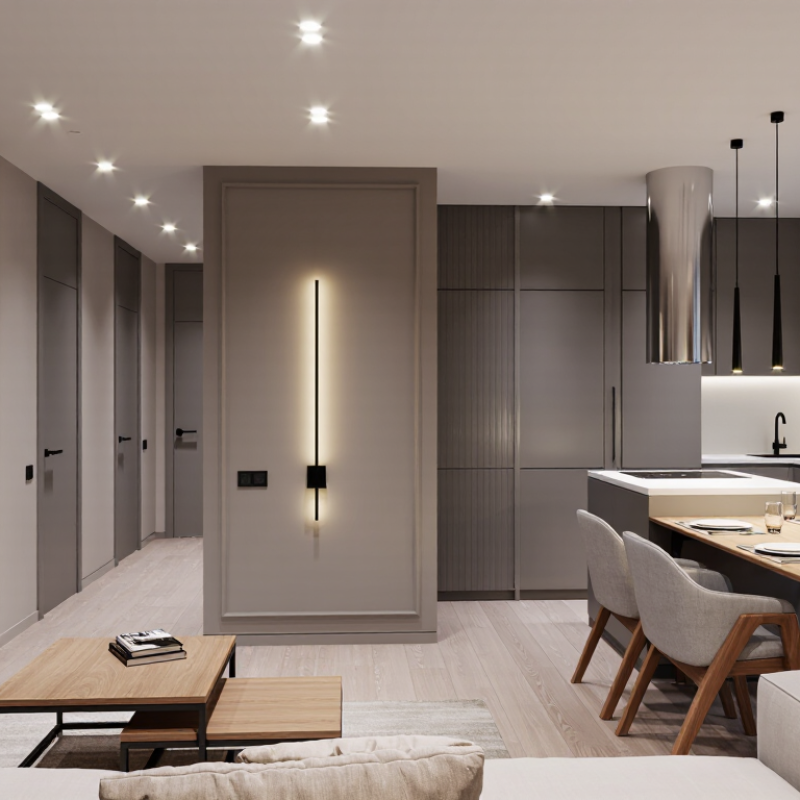
Overview of China’s Residential Interior Lighting Supply Industry
China’s residential interior lighting supply industry combines component makers, assembly workshops, optical design teams, and export-oriented manufacturers. Suppliers produce ceiling lights, pendant fixtures, wall lamps, and recessed downlights for apartments and houses. Their capabilities vary: some focus on high-volume standard models, while others handle smaller custom runs. This range can help buyers match products to room size, ceiling height, and budget. Details matter. A warm bedside light, for example, needs different glare control from a bright kitchen fixture.
The supply chain often brings together LED modules, drivers, metal or glass housings, and finishing services. Buyers should check more than appearance: request test reports, confirm dimming compatibility, and inspect samples under realistic room conditions. A finish that looks smooth in a catalog may show uneven color under daylight. Supplier communication and production consistency also deserve close attention, especially when specifications change. Not every factory handles every detail equally well. That is worth admitting. Clear drawings, agreed tolerances, and documented quality checks can reduce misunderstandings, though they cannot remove every production risk.
China Top 10 Residential Interior Lighting Suppliers – Overview of China’s Residential Interior Lighting Supply Industry
The profiles below describe common, anonymized supplier segments and manufacturing clusters. They are not named companies or a verified ranking of individual suppliers.
| No. | Anonymized Supplier Segment | Typical Residential Products | Common Manufacturing Cluster | Useful Sourcing Checks |
|---|---|---|---|---|
| 1 | Decorative pendant and chandelier makers | Pendants, chandeliers, decorative ceiling fixtures | Guzhen, Zhongshan, Guangdong, a major lighting manufacturing and trading hub | Fixture dimensions, finish samples, suspension hardware, packaging and installation instructions |
| 2 | Recessed downlight specialists | Fixed and adjustable LED downlights, retrofit downlights | Guangdong lighting-manufacturing clusters, including Zhongshan | Cut-out size, ceiling clearance, beam angle, dimmer compatibility and thermal performance |
| 3 | Ceiling-light manufacturers | Flush-mount and surface-mounted LED ceiling lights | Zhongshan and nearby Guangdong production areas | Lumen output, color temperature, diffuser quality, driver access and replacement options |
| 4 | Track and adjustable-spotlight suppliers | Track heads, track rails, surface-mounted spotlights | Guangdong lighting clusters | Track-system compatibility, circuit configuration, beam control and accessory availability |
| 5 | Linear and cabinet-lighting suppliers | LED strip systems, linear fixtures, under-cabinet lights | Guangdong, with electronics and component sourcing links in the Pearl River Delta | Cut lengths, connectors, power-supply matching, heat management and color consistency |
| 6 | Smart residential lighting suppliers | App-controlled lamps, tunable-white fixtures and connected lighting products | Shenzhen and other Pearl River Delta electronics and lighting centers | Wireless protocol, app support, firmware updates, network security and regional compatibility |
| 7 | Table and floor-lamp manufacturers | Desk lamps, bedside lamps, reading and floor lamps | Ningbo and other established lighting and household-goods production areas | Stability, cord and plug specifications, switch design, shade materials and electrical safety |
| 8 | Bathroom and mirror-light suppliers | Vanity lights, mirror lights and bathroom-rated fixtures | Guangdong and Zhejiang lighting and sanitary-product supply chains | Ingress-protection rating, installation location, corrosion resistance and applicable market requirements |
| 9 | LED driver and lighting-component suppliers | Constant-current and constant-voltage drivers, dimming components and control gear | Shenzhen, Zhongshan and wider Pearl River Delta electronics supply chains | Electrical input range, output current, dimming method, protection features and test documentation |
| 10 | OEM and ODM residential-lighting factories | Customer-designed or customized indoor fixtures across multiple product types | Concentrated in major manufacturing regions such as Guangdong and Zhejiang | Tooling ownership, sample approval, quality-control process, production lead time and export documentation |
Note: Manufacturing locations are common industry clusters, not exclusive production locations. Confirm product-specific safety, labeling and certification requirements for the destination market before placing an order.
FAQS
Common products include ceiling lights, pendants, wall lamps, recessed downlights, and track lights. Some suppliers focus on standard models; others accept smaller custom orders.
Consider ambient, task, accent, decorative, and smart lighting. A kitchen counter needs focused light, while a pendant may create atmosphere without lighting every surface.
Request test reports and product samples. Check dimming compatibility, materials, finish consistency, and replacement-part availability. Catalog photos can hide uneven finishes.
Daylight, wall colors, and room size can change how a finish or color temperature looks. Try a bedside light beside the actual bed. Small differences matter.
Compare brightness, color temperature, beam angle, and installation depth. A low-wattage light can still miss a desk or kitchen work surface.
The U.S. Department of Energy says LEDs use at least 75% less energy and last up to 25 times longer than incandescent lighting. That comparison does not cover every fixture type.
Custom sizes or finishes may better suit a room, but they can extend delivery times. Confirm drawings, tolerances, and quality checks in writing. Production risks remain.
No. Some specialize in bathroom or bedside lights; others offer design support, controls, or packaging. I might be giving catalogs too much credit—samples reveal more.
Conclusion
China’s residential interior lighting industry offers a broad range of solutions for homes, from ambient ceiling fixtures and recessed lights to task lighting, decorative pendants, wall lamps, and energy-efficient LED systems. This overview explores the sector’s supply landscape and the product categories commonly used to create comfortable, functional living spaces. It also considers how Residential Condominium Interior Lighting can address different room layouts, design preferences, and everyday lighting needs.
The article profiles ten Chinese suppliers and outlines practical criteria for evaluating their capabilities, including product range, manufacturing experience, quality management, relevant certifications, customization options, and after-sales support. A comparison of supplier services and strengths helps readers understand how to assess potential partners and identify solutions suited to project requirements, budgets, and delivery expectations.
