Decorative Architectural Metal Screens do more than dress a facade; they filter daylight, soften views, and add depth. For buyers, the right choice must balance appearance with climate, fixing method, maintenance, and budget. The IEA’s 2023 Global Status Report for Buildings and Construction gives useful context. It reports that building operations used about 30% of global final energy in 2022 and produced 26% of energy-related emissions. The World Green Building Council’s Bringing Embodied Carbon Upfront report estimates that building materials and construction contribute around 11% of global emissions. These figures do not prove that screens alone save energy. Orientation, glazing, screen depth, and local climate all matter.
Architect Louis Kahn captured the relationship between buildings and sunlight: “The sun never knew how great it was until it struck the side of a building.” Details matter. This guide introduces ten screen options, from crisp laser-cut panels to warm-toned perforated metal and bold expanded mesh. It will help you compare materials, finishes, openness, privacy, corrosion resistance, and installation needs. Look closely at the sample: a small change in aperture can alter the view, shadow, and airflow. A reflective finish may also look different outdoors than it does under showroom lights. Not every attractive panel suits every site. Treat rankings as a starting point, then confirm performance with product data, samples, and project-specific advice.
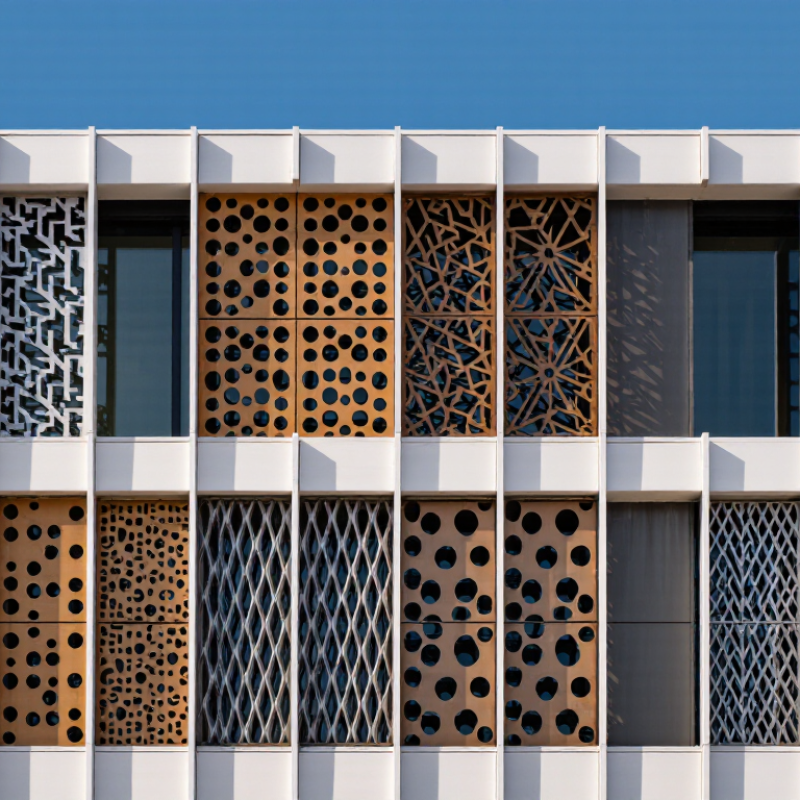
Decorative architectural metal screens are panels designed to shape space while adding pattern, texture, or partial privacy. They may be made from steel, aluminum, or other suitable metals, with openings formed by perforation, cutting, or woven construction. The screen is not always a solid barrier. Light and air can pass through, depending on the pattern and opening size. That balance matters. A dense design can soften views, while a more open panel may cast lively shadows across a wall or floor.
Common uses include exterior façades, balcony guards, courtyard dividers, entry features, and interior partitions. In practice, a screen near a sunny window can reduce glare, but its performance depends on orientation and spacing. A panel beside a busy walkway may offer visual separation without fully blocking sound or views. For exterior projects, material, finish, drainage, and fixing details should suit local weather and the supporting structure. Small details count. Ask for drawings or samples, since a pattern that looks delicate on a screen may feel quite bold across a full façade. And not every design choice is easy to reverse once installed.
When buyers compare decorative architectural metal screens, material choice should follow the building’s environment. Aluminum is lightweight and resists corrosion, making it practical for façades and balcony dividers. Stainless steel offers strength, a clean appearance, and better performance in humid locations. Weathering steel creates a rich, rust-like surface, but runoff may stain nearby paving. That detail is often missed.
Finishes change both appearance and service life. Powder coating provides consistent color and a tough surface for many exterior applications. Anodizing preserves aluminum’s metallic character and can produce subtle bronze, silver, or black tones. Brushed, mirror-polished, and bead-blasted finishes reflect light differently. Request a physical sample. Digital color previews can be misleading.
Manufacturing methods affect precision, cost, and installation. Laser cutting suits detailed patterns and clean edges, while CNC routing works well for thicker plates and repeated forms. Perforation is efficient for regular geometric designs. Welded frames need controlled alignment, especially across large panels. I have seen beautiful drawings fail because fixing points were ignored. Specify panel dimensions, edge treatment, drainage, and allowable tolerances before production. Check coating thickness and adhesion through documented quality inspections. Small imperfections may remain visible under strong sunlight, so mock-up testing is worth the extra time.
Choosing the right decorative architectural metal screen requires more than attractive patterns. Start with the metal type and its environment. Stainless steel suits humid areas, while aluminum reduces weight on balconies and façades. Outdoor exposure demands a durable protective finish. Ask for coating specifications, salt-spray data, and maintenance instructions.
Safety should guide every measurement. Check panel thickness, frame strength, fixing points, and wind-load performance. A screen may look solid but flex when exposed to strong gusts. Confirm local building requirements, especially for guards, stairs, and elevated installations. Measure openings carefully, including corner conditions and drainage gaps. Small errors become expensive during fabrication.
Request physical samples before placing a large order. Touch the edges, inspect welds, and view the finish under direct sunlight. Pattern density also affects privacy, airflow, shadows, and cleaning effort. I once underestimated afternoon glare from a polished surface. It looked refined indoors, then became uncomfortable outside. That mistake changed my evaluation process. Ask how the screen will age, not only how it looks today. Review installation drawings with a qualified contractor. Also check replacement options, lead times, and whether fasteners match the surrounding material. A cheaper panel can demand more labor later. That detail is easy to miss.
Decorative Architectural Metal Screens: Ten Styles to Consider
Choosing a decorative architectural metal screen involves more than selecting an attractive pattern. The screen must suit the building, climate, privacy needs, and maintenance plan. Geometric perforated panels create precise shadows and strong visual rhythm. Laser-cut botanical designs add softer, nature-inspired detail. Horizontal slatted screens offer airflow and a clean contemporary appearance. Vertical fins can improve privacy while emphasizing a building’s height. Traditional lattice patterns work well for courtyards, balconies, and garden boundaries.
Woven metal screens bring texture and partial transparency. Ribbed panels create changing highlights as daylight moves across the surface. Folded screens add depth and can make a flat façade appear more dynamic. Patinated metal provides a weathered character, though color changes may be uneven. Expanded metal mesh is lightweight, practical, and suitable for ventilation zones. Custom abstract patterns allow a distinctive identity, but complex designs can increase fabrication costs. Attractive does not always mean practical. A small opening may trap dust, while a delicate edge may need extra reinforcement.
Tips: Request a physical sample before approving the finish. Check visibility at morning, noon, and evening. Confirm panel thickness, fixing points, drainage, and local wind requirements with qualified professionals. Powder coating may suit sheltered areas, but exposed coastal sites often need stronger corrosion protection. Review cleaning access, too. This detail is easy to overlook. A beautiful screen can become disappointing when maintenance is difficult.
| Screen Style | Typical Material | Visual Character | Common Applications | Light and Privacy | Buyer Considerations |
|---|---|---|---|---|---|
| Laser-Cut Geometric | Aluminum, carbon steel, or stainless steel | Precisely cut repeating shapes such as circles, diamonds, or hexagons | Façades, balcony panels, partitions, and privacy screens | Openings can be sized to balance daylight, airflow, and screening | Review the pattern scale, panel support, edge finish, and corrosion protection for the installation environment. |
| Perforated Metal | Aluminum or steel sheet | Regular round, square, or slotted perforations | Building envelopes, sunshades, equipment enclosures, and interior dividers | Perforation size and spacing affect visibility, ventilation, and shading | Ask for the open-area percentage and confirm that the selected panel thickness suits the span and loading. |
| Expanded Metal | Expanded steel or aluminum sheet | Diamond-shaped mesh formed from a single slit-and-stretched sheet | Walkway guards, façades, screening, and service-area barriers | Generally allows airflow and partial visibility through the mesh | Check mesh orientation, strand dimensions, edge treatment, and whether a flattened or raised profile is preferred. |
| Woven Wire Mesh | Stainless steel or galvanized steel wire | Interlaced wires create a fine, textured grid | Interior partitions, balustrade infill, façades, and feature walls | Visibility and light transmission vary with wire size and weave | Confirm attachment details and tensioning requirements; fine mesh can collect dust and may need regular cleaning. |
| Architectural Wire Mesh | Stainless steel wire and rods | Distinctive woven or linked patterns with a strong metallic texture | Exterior cladding, atriums, stair enclosures, and large interior screens | Can provide a degree of transparency while softening direct views | Review panel size, connection method, movement allowance, and the appearance of the mesh from both sides. |
| Vertical-Fin Screen | Aluminum or coated steel | Parallel vertical blades create a ribbed, architectural rhythm | Solar-control façades, window screens, parking structures, and entrances | Blade spacing and angle influence shade, airflow, and sightlines | Consider the sun orientation, blade depth, wind exposure, and access for cleaning behind the fins. |
| Horizontal-Louver Screen | Aluminum or galvanized steel | Horizontal slats with a clean, linear appearance | Mechanical screening, façades, privacy barriers, and ventilation openings | Slat pitch and profile can admit airflow while limiting direct views | Check airflow requirements, water-shedding details, fixing points, and the visibility of equipment behind the screen. |
| Decorative Cast-Metal Panel | Cast aluminum or cast iron | Relief patterns with sculpted depth and traditional or ornate detailing | Entry screens, garden walls, courtyard dividers, and heritage-inspired projects | Openings and relief depth determine privacy and shadow effects | Cast panels can be heavier than sheet products; confirm support capacity, finish durability, and replacement availability. |
| Corrugated Metal Screen | Coated steel or aluminum sheet | Repeated ridges create strong shadows and a simple industrial texture | Service yards, boundary screens, façades, and contemporary interiors | Solid sheets provide substantial visual screening; perforated versions allow more airflow | Specify the sheet profile, coating, panel direction, and corrosion protection appropriate to the site. |
| Custom Motif Screen | Typically laser-cut aluminum or steel | Project-specific patterns, symbols, organic forms, or site-inspired artwork | Feature façades, lobbies, public spaces, and landscape partitions | Pattern density can be adjusted to control daylight, privacy, and visual impact | Request a scale drawing or sample; intricate patterns may require careful review of minimum feature size and structural bridges. |
Choosing a decorative metal screen starts with the project’s purpose, not appearance alone. A courtyard may need patterned privacy, while a retail frontage may require visibility and airflow. Perforated panels suit modern facades, while laser-cut designs create sharper shadows and stronger visual identity. Check panel size, fixing points, wind exposure, and local fire requirements before ordering. Small details matter.
Budget changes the best material choice. Aluminum is lightweight and often simpler to install, while steel can provide greater rigidity for larger screens. Stainless steel performs well in demanding environments but usually costs more. In coastal locations, specify suitable corrosion protection and inspect cut edges carefully.
I once focused too much on the pattern and underestimated access for cleaning. That mistake increased installation time. Maintenance should be planned before approval, not after installation.
Tips: Request finish samples outdoors, not only under showroom lighting. Compare full installed costs, including frames, lifting equipment, and labor. Ask how often surfaces need washing in your climate. Leave safe access behind fixed panels. For high-touch areas, avoid deep grooves that collect dust. If privacy is important, review the screen from both sides at different times of day. A beautiful design can still fail when glare, fingerprints, or poor drainage are ignored.
It is a metal panel that adds pattern, partial privacy, or texture. Openings can let light and air pass through.
They appear on façades, balconies, courtyards, entryways, and interior partitions. Placement changes how much privacy they provide.
Smaller openings can soften views, while larger ones allow more light and airflow. They may also cast shadows across nearby floors.
Aluminum is lightweight and often simpler to install. Steel can offer more rigidity, while stainless steel may suit demanding environments at higher cost.
Review panel size, fixing points, wind exposure, drainage, and the supporting structure. Request drawings or samples; small details can be hard to change later.
View the screen from both sides at different times of day. A pattern may look private in a showroom but feel quite open outdoors.
Climate, finish, and surface details all matter. Deep grooves can collect dust, and coastal locations may need suitable corrosion protection.
Compare the full installed cost, including frames, lifting equipment, and labor. I once overlooked cleaning access; installation took longer than expected. A sample alone may not reveal everything.
Decorative Architectural Metal Screens combine visual appeal with practical performance, making them useful for facades, privacy partitions, balcony guards, room dividers, ceilings, and landscape features. This guide explains how materials such as aluminum, steel, and weather-resistant alloys differ, along with the effects of powder coating, anodizing, patination, perforation, laser cutting, and woven construction. Understanding these options helps buyers select screens that suit both the appearance and function of a project.
Before purchasing, evaluate the screen’s strength, corrosion resistance, dimensions, installation requirements, maintenance needs, and total cost. The guide presents ten design styles, ranging from geometric patterns and organic motifs to minimalist panels and three-dimensional forms. It also shows how to match Decorative Architectural Metal Screens with project type, budget, climate, privacy expectations, lighting goals, and long-term upkeep, helping buyers make a confident and practical selection.